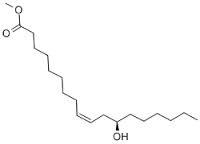
| Methyl Ricinoleate |
| PARAMETERS | SPECIFICATIONS |
| Synonyms | RICINOLEIC ACID METHYL ESTER, METHYL ESTER OF RICINOLEIC ACID |
| CAS No. | 141-24-2 |
| Formula | C19H36O3CH3(CH2)5CH(OH)CH2-CH=CH(CH2)7 COOCH3 |
| Mol. Wt | 312.45 |
| Purity | Min. 85% Ricinoleate by GC |
| Description | Pale yellow to Dark Yellow Liquid |
| Acid Value | 3.0 Max. |
| Saponification Value | 174 - 187 |
| Iodine Value | 78 - 88 |
| Hydroxyl Value | 160 - 172 |
| Moisture | 0.75% Max. |
| Uses | Methyl Ester of Castor Oil is used in place of Castor Oil in the production of hydraulic fluids. Methyl Ricinoleate is found to be of use in ethyl cellulose, nitrile rubber, nitrous and polyvinyl butyral lacquers. |
Acme Synthetic Chemicals is the Manufacturer, Supplier & also Exporter of Methyl Ricinoleate.
Methyl Ricinoleate - Lubricant is also known as Methyl Ester of Ricinoleic Acid & Ricinoleic Acid Methyl Ester which is classified under CAS No. 141-24-2.
Acme Synthetic Chemicals is one of the reputed organizations engaged in providing superior quality Methyl Ricinoleate - Lubricant (Ricinoleic Acid Methyl Ester, CAS No.141-24-2) to our esteemed clients.
Methyl Ricinoleate - Lubricant (Ricinoleic Acid Methyl Ester, CAS No.141-24-2) is used in several lubricating formulations, cutting oils and gear oils, motor fuels, cylinder lubricants etc.
Methyl Ricinoleate - Lubricant (Ricinoleic Acid Methyl Ester, CAS No.141-24-2 ) is also used as a plasticiser in several industries such as phenolic moulding resins, spray resin systems, rubber polymers etc.
Methyl Ricinoleate - Lubricant (Ricinoleic Acid Methyl Ester, CAS No.141-24-2) delivers additional benefits of anti- rusting and corrosion.
Methyl Ricinoleate - Lubricant (Ricinoleic Acid Methyl Ester, CAS No.141-24-2 ) use as dispersing agent, mulsion stabilizer, conditioning agent, emollient in personal care products.
Methyl Ricinoleate - Lubricant (Ricinoleic Acid Methyl Ester, CAS No.141-24-2 ) use as a plasticizers in pharmaceuticals industries & as perfumery chemicals in cosmetic industries.
We can offer Methyl Ricinoleate - Lubricant (Ricinoleic Acid Methyl Ester, CAS No.141-24-2) in drums / FCL Lots and ISO Tanks.
Methyl Ricinoleate - Lubricant (Ricinoleic Acid Methyl Ester, CAS No.141-24-2 ) is packed in 190 kg HMHDPE ( plastic ) drums.
Each FCL can take 80 drums of Methyl Ricinoleate - Lubricant (Ricinoleic Acid Methyl Ester, CAS No.141-24-2).
An ISO tank can take between 18 to 20 tons of Methyl Ricinoleate - Lubricant (Ricinoleic Acid Methyl Ester, CAS No.141-24-2 ).
Our current capacity for Methyl Ricinoleate - Lubricant (Ricinoleic Acid Methyl Ester, CAS No.141-24-2 ) is 1200 tons per annum.
This Methyl Ricinoleate - Lubricant (Ricinoleic Acid Methyl Ester, CAS No.141-24-2) is widely demanded in the international market due to its high effectively, eco-friendliness & purity, and is offered in different packaging options to meet the varied needs of our clients.
The offered product Methyl Ricinoleate - Lubricant (Ricinoleic Acid Methyl Ester, CAS No.141-24-2) is formulated using supreme class ingredients and modern techniques by our team of skilled professionals as per the set industry norms at our state-of-the-art processing unit.
Methyl Ricinoleate is designed to support a broad spectrum of lubrication needs, ranging from metalworking to textile and leather processing. Its stable viscosity and wide operating temperature range ensure reliable performance in critical, high-temperature environments.
With a purity level above 98% and minimal ash and water content, this lubricant offers consistent quality and superior stability. The product resists oxidation and maintains its integrity, even during extended use, contributing to the longevity of machinery.
Packaged in robust 200L HDPE drums, Methyl Ricinoleate is easy to handle and transport. The product is not classified as hazardous, making storage straightforward. Custom packaging options are available to accommodate diverse operational requirements.
FAQs of Methyl Ricinoleate - Lubricant:
Q: How is Methyl Ricinoleate used in high-temperature lubrication applications?
A: Methyl Ricinoleate is applied directly as a lubricating agent for machinery operating at temperatures between -10C and 220C. Its high flash point and stable viscosity ensure effective friction reduction and protection under demanding conditions.
Q: What are the main benefits of using Methyl Ricinoleate over conventional lubricants?
A: Methyl Ricinoleate offers excellent thermal stability, low water and ash content, and high purity, resulting in prolonged equipment lifespan and reduced maintenance. Its vegetable ester composition also provides environmental advantages compared to mineral-based oils.
Q: When should Methyl Ricinoleate be replaced or replenished in machinery?
A: It is recommended to follow machinery manufacturer guidelines for lubricant replacement. Generally, monitor lubricant condition regularly and replace it before the end of its 24-month shelf life or if performance decreases due to contamination or breakdown.
Q: Where is Methyl Ricinoleate typically applied within various industries?
A: This lubricant finds use in industrial and automotive sectors, particularly in metalworking fluids, hydraulic oils, textile machinery, and leather processing units. It is valued especially where high-temperature performance and mild odor are necessary.
Q: What is the process for storing Methyl Ricinoleate safely?
A: Store Methyl Ricinoleate in tightly sealed HDPE drums in a cool, dry area. Because it is not regulated as a hazardous material, handling is straightforward, but the product should remain protected from direct sunlight and moisture.
Q: Can Methyl Ricinoleate be blended with other lubricants or additives?
A: Yes, due to its solubility in alcohol and ether, it can be formulated with compatible additives to enhance specific properties such as wear resistance or oxidation stability. Always conduct compatibility tests before large-scale blending to ensure optimal performance.
Q: What packaging options are available for Methyl Ricinoleate?
A: The standard packaging is a 200-liter HDPE drum, but custom volumes and packaging types can be arranged upon request to suit diverse logistical and operational needs.







 Send Inquiry
 Send Inquiry
 Send SMS


